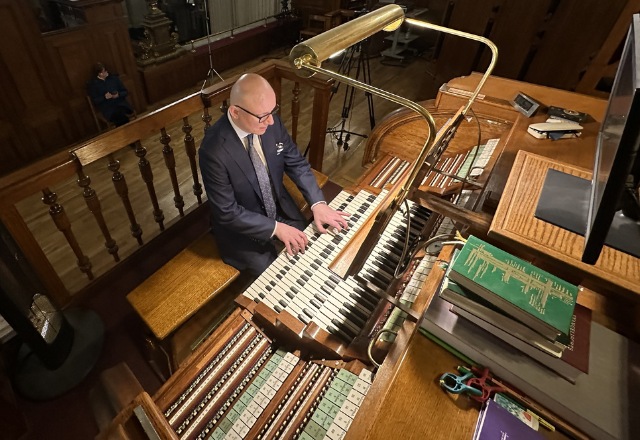
It is almost a year ago when I accompanied Dr Joseph Nolan, award winning organist and personal friend, to assist with his epic recordings of the complete works of Alkan at the organ in St Martins Church Dudelange in Luxembourg.
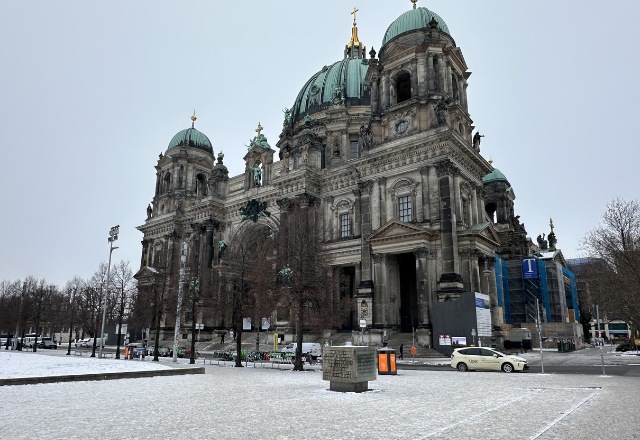
A new recording adventure begins
This four-night, epic recording challenged us all to the extreme. The programme for the Berliner Dom recording was far less intense, comprising of Liszt’s mighty Ad Nos and Jonathan Scott’s arrangement of Saints Saens Organ Symphony No 3 in C minor (complete).
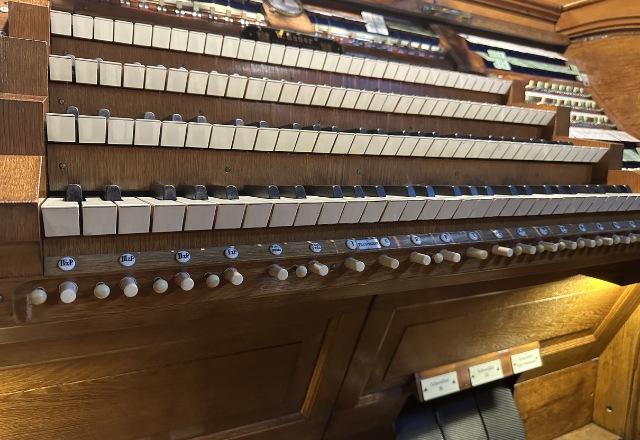
On paper this appeared to be a far easier workload. However, the Berliner Dom organ, being a historical instrument, possessed just 4 preset pistons and few couplers activated by thumbs or feet. We were a little uneasy that changing the organ colours quickly could prove to be a bridge too far for the Saint-Saens.
Braving Berlin’s Chill
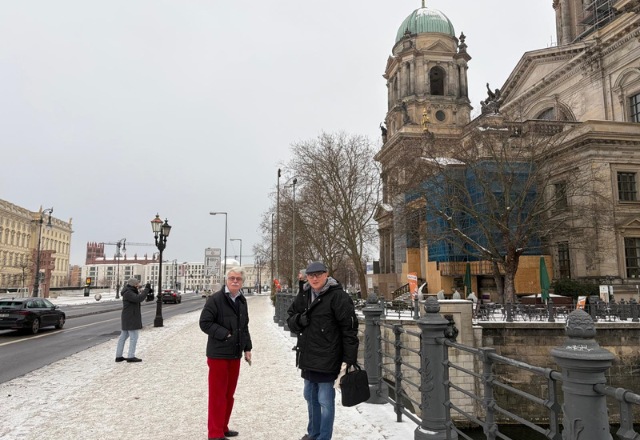
We arrived in Berlin on January 8 and were greeted by temperatures of about minus 5 and pavements covered in frozen icy snow. The nearby rivers were also frozen, so it was fortunate that we had booked a hotel just 300 meters from the Dom. We were soon informed that our hotel of choice, the Radisson Collection, used to house a huge central fish tank about 30 metres tall in the central lobby. The tank apparently ruptured a few years ago destroying the ground floor and most of the fish. This was an incident that was reported on German national news.
Meeting Professor Sieling and the Sauer Organ
The following day we were greeted by Berliner Dom Organist, Professor Andreas Sieling, who was the most charming and well-dressed gentleman in the Bavarian style. Professor Sieling gave us a brief tour of the instrument and demonstrated the rollschweller feature as part of a beautiful improvisation.
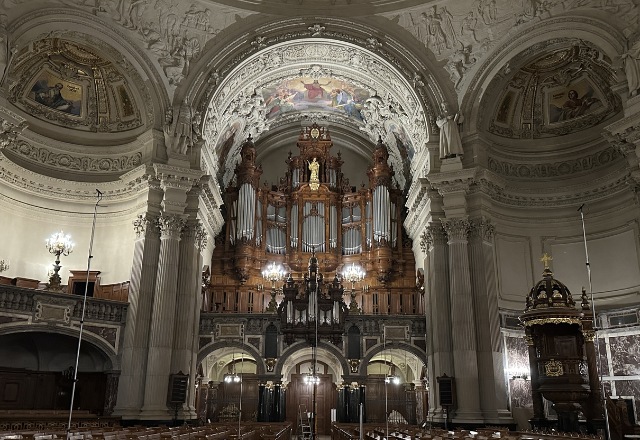
The instrument was built in 1905 by Sauer and remains unaltered from the original specification. The sound is magnificent, thunderous and is an instrument that all organists would want to visit and enjoy. The action is pneumatic and silent, unlike Barker Lever instruments.
We were to discover in the recording sessions that many rapid changes of registration in the Saint-Saens were not the only impasse to recording the complete transcription of the Saint-Saens, but more of this will emerge later in the story.
Grappling with historic technology
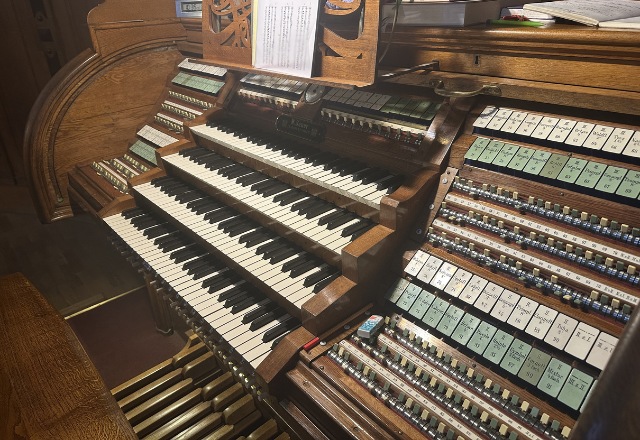
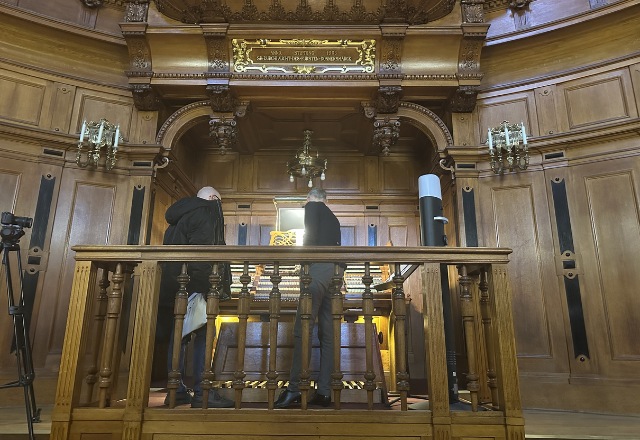
I will digress briefly into a description of the mechanical aids which were no doubt leading edge back in 1905. You will see in the picture of the jambs a series of switches in triplicate below the departmental rocker tabs, I have marked these up in the photograph of the left jamb.
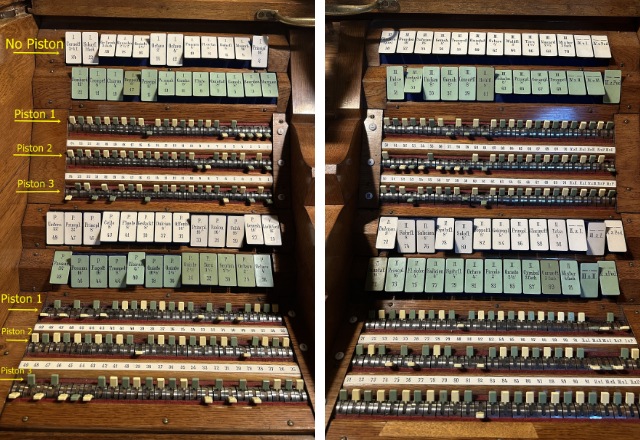
These relate to the 3 general combination pistons below the bottom manual. The little tab levers mimic the action of turning the stops on and off so you can in effect set 3 different stop settings by using the tabs which carry the same number as the stop they mimic. This is an identical facility that I saw on UK organs from the 1960’s where to set a piston you went to a separate box of switches and set them to on or off for the stops you wanted the piston to activate. The box was usually more hidden than the similar facility found on this console. It was designed to be set up just occasionally and not quite in the same way as we find here.
Eventually we got the hang of it but on numerous occasions, as we were exploring different stop combinations, it was all too easy to adjust the large rocker tabs when one needed to move a small tab and this error cascaded into work of having to fix a problem created by accident in two places! Quick changes of the pistons were out of the question, so we changed our thinking to use of the rollschweller.
The Rollschweller revelation
The rollschweller is similar to crescendo pedals that add and subtract stops in a predefined way to provide an organised crescendo and decrescendo facility. It required about 4 complete revolutions to go from ppp to fff in a smooth manner.
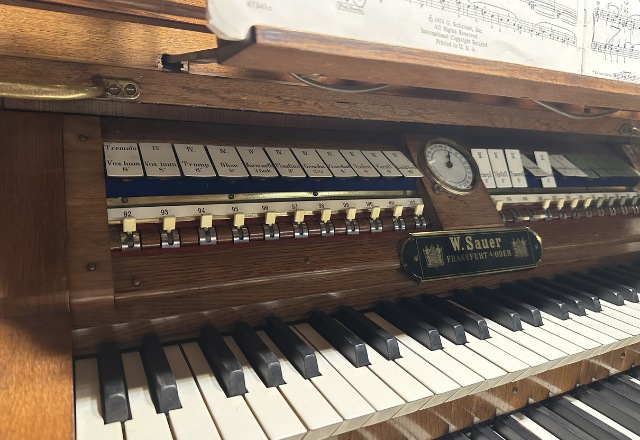
There is a clock dial above the 4th manual to show its position indicating a total of 104 stages. We could not change these, but it did provide a near seamless change of volume levels. So, we quickly appreciated we had another helpful facility beside the 4 piston presets. The only minor drawback being the crescendo facility required pulling the cylinder toward the body, so this work inevitably drew one’s body toward the console and the effort required to rotate the cylinder increased the more it was rotated! All making playing loud and fast a bit more difficult.
Eventually at times management of the rollschweller was delegated to me so I had to stick my left leg across the pedal board keeping it away from pedal notes. This is because Joseph needed to play quite often in the high register of the very straight and non-concave pedalboard.
Then there was the matter of not missing the page turn or coordinating the two tasks! This was a new skill I had picked up by the end of the recording.
A remarkable restoration
The Berliner Dom building fell into the East German sector after WW2. The building became seriously neglected and I was told part of the roof was open to the elements with water pouring into the organ which became unplayable.
There is one wooden panel still visible in the organ loft where Russian graffiti can still be seen and apparently the organ was also damaged by gun fire.
After the wall came down, funds were raised to repair the building and the organ. It is remarkable that the restoration has more-or-less totally preserved the clever engineering of the original build.
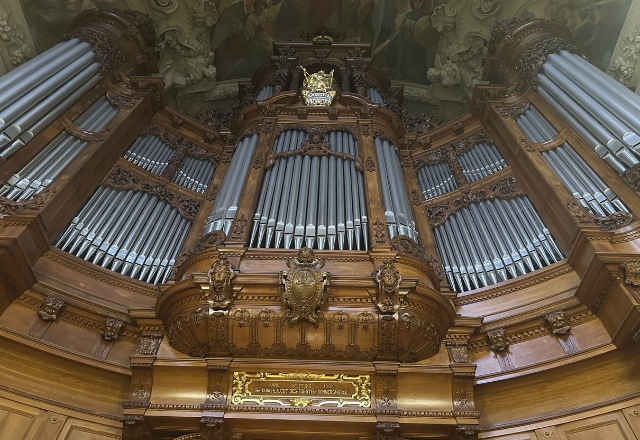
However, when it comes to performing on the instrument one would be greatly relieved to have the facility of a modern capture action to ease the stresses playing a large instrument inevitably creates. Nevertheless, the historic integrity of such a wonderful instrument deserves to be preserved and respected.
Swell shoes in reverse
Another anomaly that took a great deal of getting used to was that the swell shoes operate in reverse! The box is closed when the swell shoe is down to the floor and closed when near vertical. The exact opposite of all other organs I have played. Do you know of other instruments where the shoes operate in this manner? If so, please let me know!
Challenges behind the console
We were afforded three rehearsals to set up the instrument ahead of the allotted three nights of recording. This allowed us to establish the best stop combinations. However, only three could be remembered by the instrument using the small tab switches.
The only solutions to speed up the process of resetting the pistons was to take photographs of the switch positions which we could then change between movements where necessary and mix those with use of the rollschweller.
Before iPhone facilities it would all have needed to be written down. The reader can imagine how much time and complication was saved by modern technology in this instance.
Liszt’s Ad Nos
The Liszt Ad Nos could not have been better suited to the organ and acoustic of Berliner Dom.
The dignity and orchestral style of the sound perfectly matched the composition, with power and piquancy being delivered in abundance via the incredibly musical Sauer Organ.
Manipulation of registration and the rollschweller also fitted the Ad Nos like a glove. In what might be a record, Joseph completed the recording of the mighty Ad Nos to the satisfaction of Signum Producer, Tim Oldham, in only two hours.
Joseph has recorded the Liszt Ad Nos before in 2009 on the legendary Cavaille-Coll Organ of St Sulpice, Paris, where I was also assisting in the recording. My personal recollection of the Ad Nos at St Sulpice was that it is nowhere near as effective as it was in Berlin.
Perhaps the huge distance of the pipework at St Sulpice so high above the console was an issue, but I feel it would be almost impossible to find an instrument that better suited the Liszt Ad Nos than Berliner Dom. Night one was over and the recording of the Liszt was done in record time with very few edits.
Moving to Saint-Saëns
The next day we moved on to the Saint-Saens. I find the original Saint-Saens Organ Symphony a very disappointing experience as a showcase for the organ and organist. There is so little organ involved and the pianist(s) have much more difficult parts to play. Therefore, I am personally grateful to Jonathan Scott for arranging the orchestral original into a version that brings the organ into full view.
This was a complicated challenge in Berlin due to need for far more extensive registration changes than in the Ad Nos. In the rehearsal sessions we were focussed on these challenges and had not really identified the issues that high-speed repetition of passagework would later present.
On night two we recorded the famous Adagio and Maestoso (Finale) – which was a very challenging task in terms of registrations. With these movements completed, we commenced recording the first movement, but the difficulties of resetting all the pistons and the lateness of the hour led to the decision to return the next evening using the morning to work out a way of managing the many and fast registration changes required.
A change in repertoire
Joseph and Tim decided very quickly at the start of recording night three that the first and third movements of the Saint-Saens – with very fast repeated semiquaver work of the same pitch – were simply too much to expect from a historical instrument.
Immediate thoughts turned to what repertoire would suit the organ like a glove and that Joseph had played many times in his career that would not require rehearsal. Mendelssohn’s Organ Sonata No.3 in A Major was chosen and downloaded to Joseph and Tim’s iPad. The Mendelssohn suited the Sauer Organ perfectly and Joseph did not need many takes to record a work he had not played in perhaps a decade.
You may wonder why Joseph didn’t opt to record Bach from his extensive library of well-rehearsed pieces. This is because Bach recordings are really the preserve of the DOM Organist and Joseph had, understandably, to seek the permission of Professor Sieling about the programme to be recorded.
Some Berlin sightseeing
We filled our daytime hours with visits to nearby museums and landmarks and a couple of tourist bus tours. Pavement walking was precarious but thankfully none of us fell over. We did drop into the nearby St Hedwig’s Catholic Cathedral which has just been massively restored and saw another wonderful looking new instrument by Klais. Sadly, time did not allow us to make a playing visit although we did contact the Cathedral organist who invited us for a later visit.
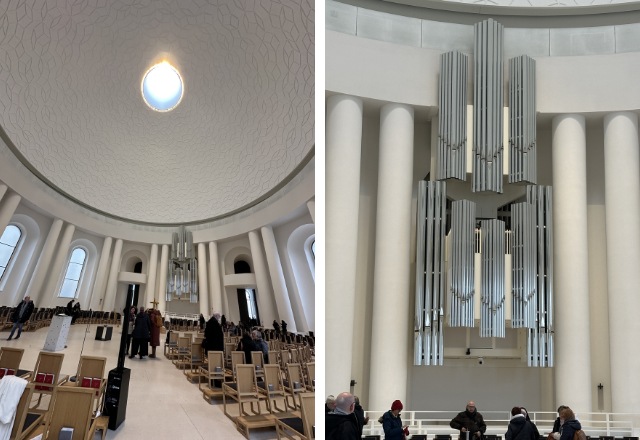
I suspect this new instrument could play a lot faster, but I rather doubt the organ, or the space, would have the same acoustic or musical impact as the Sauer organ in the Dom. Perhaps a return visit will allow this question to be answered.
Here are a couple of brief recordings.
Me playing a hymn tune composed by my grandfather, a FRCO and organist in Pontypridd and Aberystwyth.
And here are Joseph playing extracts from the Liszt Ad Nos, and the Adagio and Maestoso from Saint-Saens Organ Symphony No 3 transcribed by Jonathan Scott.

I have had a passion for church organs since the tender age of 12. I own and run Viscount Organs with a close attention to the detail that musicians appreciate; and a clear understanding of the benefits of digital technology and keeping to the traditional and emotional elements of organ playing.


