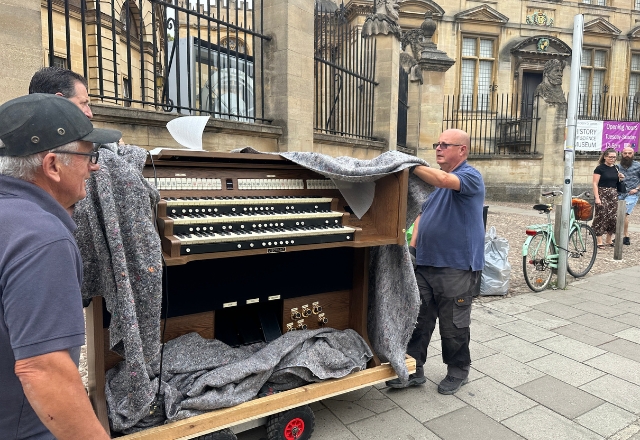
We recently shared the interesting origins of the Sheldonian Theatre’s organ where we shared that we’d installed a Envoy 350-FV. Here I share how the voicing of this instrument went.
The Sheldonian challenge, voicing in a dry space.
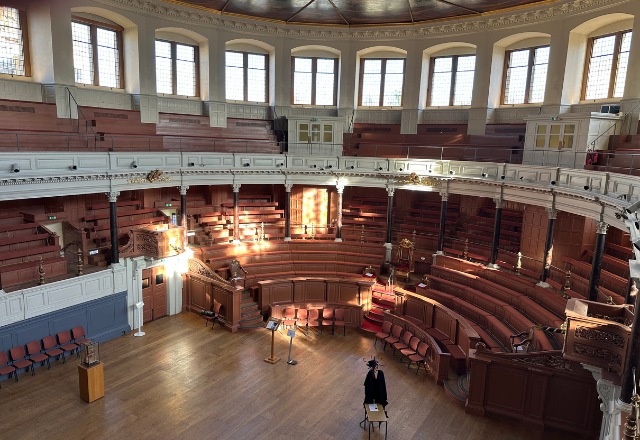
Voicing a digital organ in a relatively “dry” space is always much more of a challenge than doing so in a reverberant space. Reverberant spaces are very forgiving, by and large, but dry spaces kick up all sorts of issues. Oxford’s Sheldonian Theatre is a lovely space but never particularly reverberant.
In recent years the rather uncomfortable steeply tiered seating has at last been upholstered. The seats are now far more welcoming for the audience but it has further reduced the reverberance. Once the theatre is filled with hundreds of people for a graduation ceremony it becomes even drier and rather noisy.
These were the main things to be considered when trying to make our new Viscount installation there sound convincing. The organ had to sound forthright and majestic enough for academic processions but not seem like something unlikely in the pipe case within which its loudspeakers were housed. It also had to be properly audible above the hubbub of some 700 people chatting.
Limited speaker space and clever adjustments
There had been very little space to house the new loudspeakers inside the existing pipe case. Many of the old speaker cabinets dating from 1999 remain in place. Their removal could only have happened if all the pipe case façade pipes had been removed. The scaffolding and cost for that had not been planned for.
Making the sound less directional
To counteract the dryish acoustics, and to attempt a more diffuse distribution of the sound, the Swell loudspeakers were eventually turned backwards, directed into the swell box whose shutters had been removed. The Great/Pedal loudspeakers, initially projecting directly through the front of the pipe case, were redirected to project upwards. These changes made for a less directional sound in the auditorium.
Refinements with Michael Koenig
The first voicing visit in late summer 2025 created a rough model from which to work, and we returned in the autumn with Michael Koenig, the Betts Scholar in organ studies, and FRCO, who was able to spend some time in the auditorium helping to refine the results. This second visit resulted in a taming of the top end of the mixtures, which tended to stand out quite prominently in the space, as well as a number of other improvements.
We were all reasonably satisfied with the results at the end of that day, having created a convincing result that could plausibly have matched the old pipe case. There had been a discussion about limiting the number of stops to resemble the original pipe specification, but there seemed to be no great enthusiasm for reducing the 50 stops available to the 33 that the last pipe organ offered.
A surprise result at the degree ceremony test
Michael Koenig quite rightly wanted to hear the results during a degree ceremony – one of the main current uses for the instrument. Organ scholars typically play a range of repertoire while visitors are gathering, during the academic procession, and at the end of the ceremony.
Michael got himself a seat at a late autumn ceremony and was surprised to find that an organ that had sounded quite bold enough in an empty theatre was somewhat inadequate in the ceremony. The general feedback suggested that the middle frequencies were most negatively affected, possibly because of the masking effect of so much human chatter. Put bluntly, the organ needed considerably more “welly”.
December adjustments for full house singing
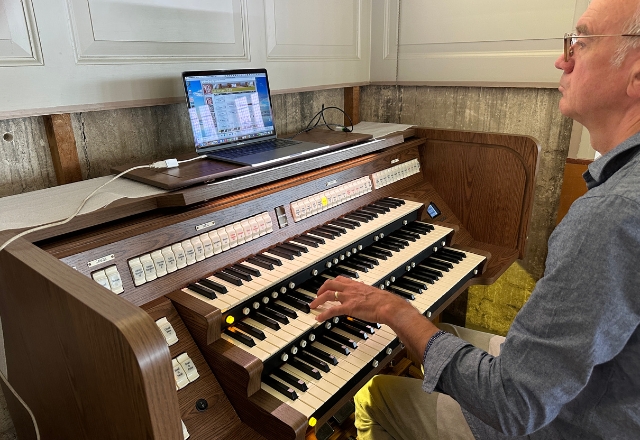
Returning in December, having in mind an imminent carol concert with a large choral society, we worked on beefing up the organ’s sound, trying to achieve a compromise between believability and scale.
Accompaniment for a theatre full of people singing carols at the tops of their voices would need more power than we had thought, but we didn’t want to push the instrument into sounding ‘coarse’. Thankfully the speakers were up to the job of handling some more power, another issue that can be challenging in dry spaces, as the sound level drops off considerably with distance and there is little reverberation to support the sound level further back in the hall.
After a further 3 hours work assisted by Michael, we were all convinced the revised voicing was a far better match to the main roles the instrument needed to fulfil.
A final touch
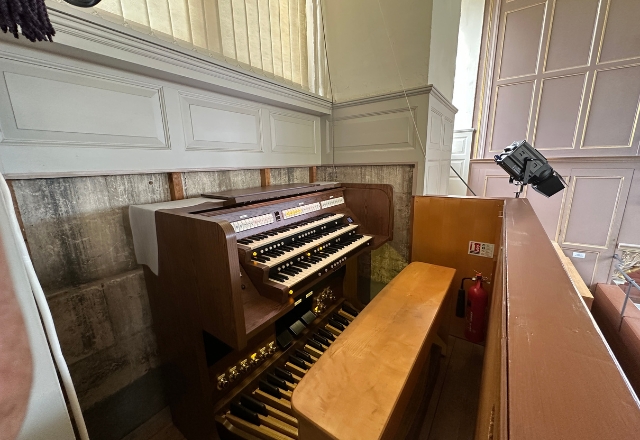
A final change was to leave a very low level of sound coming from the console. The Sheldonian organ loft, like so many organs, is very badly placed for the organist to get a good sense of what the audience will be experiencing. This low-level monitor sound will provide some local reproduction of the organ sound to the musician, particularly useful when there is noise in the auditorium.
A nod to the past, and what’s still to come
Shortly after completing this 3rd voicing session a friend directed me to a recording of the Sheldonian pipe organ made in August 1990. By then it was a Harrison & Harrison rebuild and enlargement of the late Victorian Willis instrument. You can listen to it on Spotify using this link. It’s just the first 3 pieces on the album played by Robin Kimber.
Despite the smallness of the pipe case the sound is clearly very large and I suspect when we return for the final voicing session in 2026 we will make our digital sound even bigger.
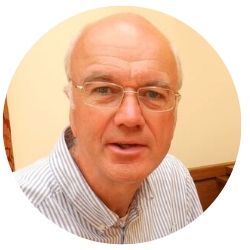
I’m a retired academic, with a background in music and audio engineering. I’m currently a consultant for Viscount & Regent Classic Organs, as well as being a freelance organist, including a role as organist/choirmaster at St Mary’s, Witney. I sing bass with Oxford Pro Musica Singers and the Cathedral Singers of Christ Church, Oxford.


I played this instrument a couple of times in 2025 and again in 2026. I thought it seemed to be sounding fuller this year, but it’s good to know from this article that I didn’t just imagine the improvement. The monitor sound at the console really helps as well. Thank you for the continued work on it, and I look forward to hearing the results of the final voicing session.