
Guest blog from one of our wonderful customers – Dr Adrienn Tomor
Getting a 3-year-old interested in the organ was the easy part. The challenge was persuading the organ to fit the 3-year-old.
Since Charlie was born, he has had access to an electric keyboard, placed on a pile of books. He could sit comfortably, reach the keys and explore instruments as part of everyday life. While the piano is excellent for developing hand coordination, I became increasingly convinced that the organ offers unique developmental opportunities. Learning to coordinate hands and feet simultaneously from a young age is likely to provide additional benefits for coordination and cognitive development.
The challenge, of course, was that organs are built for adults.
Finding the right instrument
After a great deal of searching, I found the Viscount Cantorum Duo Plus with a 30-note MIDI pedalboard to offer a solution. The flexible setup meant that, unlike a traditional console, it could be adapted for a child.
I wanted a setup that both Charlie and I could play. That meant the relative height of the keyboards, pedals and bench all needed to be adjustable.
Solving the height problem
Mounting the keyboards on an electric height-adjustable desk was relatively straightforward. However, I could not find a desk that was low enough for Charlie to reach the pedals. I therefore had to raise the pedalboard and create a bench that would fit a 3-year-old but could be adjusted as he grows.
As an engineer, the real challenge was not building it. It was working out the dimensions. I spent quite some time with a tape measure trying to design a standard organ console for a toddler. Unsurprisingly, there is not a great deal of published guidance on the subject!
Building the bench
As my DIY facilities are fairly limited, I needed simple solutions. Eventually, I chose a dining table and bench set that was about the right width. By cutting them to size and joining the two benches together, I had a seat wide enough for the pedalboard. I then raised the pedals so that Charlie could reach them comfortably.
The finished result is not a masterpiece of furniture making. It will not be troubling professional organ builders any time soon. However, it is sturdy enough and it works.
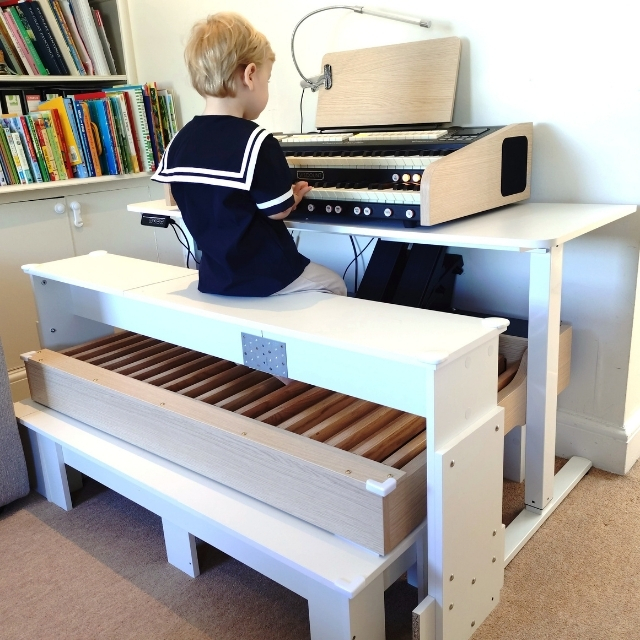
Charlie at the console
Charlie can now comfortably reach both manuals and pedals. When I want to play, I simply raise the keyboards using the electric desk. The only unresolved engineering challenge is finding an equally simple solution for raising the bench for an adult, ideally without involving a small pile of books.
Charlie absolutely loves his organ. He plays it several times a day, experimenting with the stops and enjoying the different sounds. He is beginning to explore simple tunes while learning to move his feet at the same time, and occasionally treats me to little concerts.
As a mother, I am delighted that he is enjoying the instrument while developing coordination and concentration at the same time.
Perhaps the most surprising lesson from this project is that the biggest barrier to introducing young children to the organ may not be ability, skill or interest. It may simply be that their feet cannot reach the pedals.
This post was written by Dr Adrienn Tomor
An academic, bridge engineer and Charlie’s mother. She spent several years as a church organist at Emmanuel Church, Exeter, and has a longstanding love of the organ. She is now exploring how younger generations can be encouraged to engage with the instrument.

I have played the church organ since the age of 11. I am organist at my local catholic church as well as accompanist for a small choral group and keyboard player in a function band. I am committed to ensuring Viscount customers get industry leading service and advice, resulting in the very best organ to suit their needs, be it church, school, home or concert hall.


Leave a Reply